- Published on

It’s been raining some here, keeping the weather thankfully cool and giving me a chance to do some painting indoors. I went to two big flea markets I love over the weekend, but I also came home after each one and did a small painting or two. Here are the still life ones. I’m very happy with the Mille feulle one, and pretty happy with the peach. At the bottom is the Cherokee purple tomato. My oil at home of several of those is my favorite of all the still lifes I’ve done so far, but this gouache totally bombed. I got it way overworked, and I don’t think the composition was that strong to begin with. I also struggled with the teapot one and walked away, but I may go back into that one again and see if I can spruce it up just a bit. A couple of artists I really admire on fb sent me encouraging words about that one.


- Published on

I got home this week, having recently done those two small gouache still lifes, and I was ready to dive back into oils. Here was the first one, just 8x8”. But it suits the tiny cherries. I don’t tend to blow things up too much. I’ve found there’s a scale I feel comfortable painting in, both for landscapes and still lifes, and it’s not successful when I try to exceed it by too much. Process shots below. I started with a gray chalk for the drawing.


- Published on

I was awarded a show at Playhouse on the Square for this September. It’s in the most visible gallery there, and also a much smaller one than the enormous, cement-walled ramp I often get assigned. I’m so grateful for the better visibility, and now I’m scrambling a little bit (since I’ll be gone most of August) to make sure I have a solid show. I’ve been enjoying the still lifes lately, but I’ve also been away from my easel. I decided to try a couple in gouache, and I had a ball doing them. This is a good travel project for August as well, so I’m tentatively titling the show “Daily Pleasures” and pursuing this line of work for it. I’ve got a handful of larger oils already, and I think I can fill out around them. My very first gallery show was still lifes, 20 years ago in 1999, so it would be nice symmetry.

- Published on


Alongside the gouache studies, I’ve been doing some more standard (for me) journal sketches along the way. Here are some from the last several days. Two of them were bicycle trips to the bakery to have a treat. I’m a late bloomer on a number of fronts, and I got my first bike out here. I never learned to cycle as a kid, and Concrete is a perfect place to catch up. There is almost no traffic in town along with quite wide streets, and best of all, there’s a green line that runs through the center of town (to within a couple of blocks of anywhere I want to go) and also goes out of town and as far as I could care to go. I can pack up art gear and take off on my new bike, a second hand cruiser. The next image has my bike in the background and bakery tea in the foreground. I wanted to record this moment in my journal.

Here is the view a few miles out the trail from town. It’s been my regular walk here, but I can go a bit further on the bike and paint new places.

Plus another blueberry pancake sketch from Perks diner here. A totally awesome place. Flower at the grill collects heart shaped rocks like I do and has begun to make me heart shaped pancakes when I come in. <3< />iv> 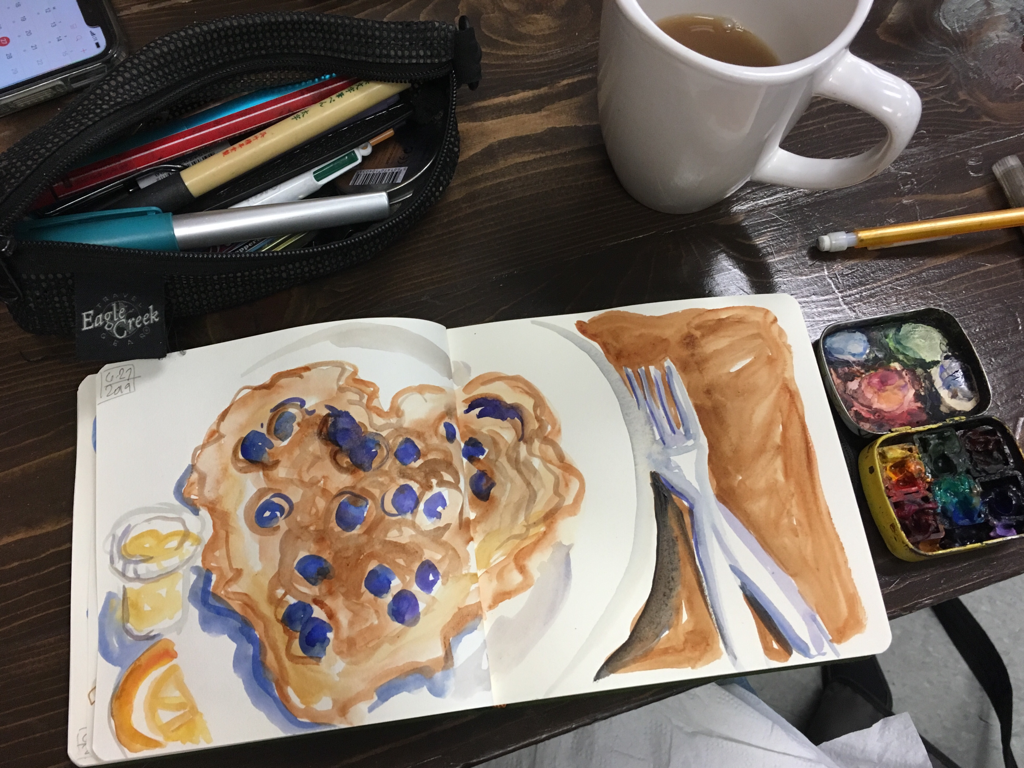
- Published on

Today’s still life is tomatoes. I bought some lovely Cherokee purple ones at the market, and I had fun painting one in the sunflower painting over the weekend. Summer tomatoes are worth celebrating, so I decided they deserved their own painting. This is the lunchtime progress, so it’s not finished yet (I’m taking a long break and doing a blog post), but I had a tomato at lunch to match my painting, so I thought that might be fun to show.
The other thing was that I kept thinking about still lifes in general while I was painting. I put up a post about them yesterday, and this painting was feeling very generic to me as I started it, right up until I started painting details into the Bridgman pottery platter the tomatoes sit on.
The other thing was that I kept thinking about still lifes in general while I was painting. I put up a post about them yesterday, and this painting was feeling very generic to me as I started it, right up until I started painting details into the Bridgman pottery platter the tomatoes sit on.

So this still life, I very intentionally chose a platter by Melissa to use. I wanted that lightness shining out of the darkness, but I also wanted some of her distinctive work and pattern included. Craft has not always been appreciated on the level of art in this country, but it is equally beautiful and often more skillful. It began to feel like a painting that was more personally mine when I put in the handiwork of a friend. I’d like to include more pottery in my still lifes to come. My first was my new Shearwater teapot I brought back from Ocean Springs when I had work at the Walter Anderson Museum of Art. Including it, aside from celebrating its beauty, was a way for me to memorialize that moment in my career. I intend to keep my still lifes personal by using items I own, things that are important to me, and things made my people who are important to me. The vase in the sunflowers is one I inherited from my Mom, and it always makes me think of her.
Back to work now (and I’ll get a better shot of this painting when I finish it), but the final photo is lunch, the one Cherokee purple in the house that is not currently posing for me. This time it’s on a plate by Perry Munn potters, the friends I visited in Arkansas last week who are also the resident potters at the Ozark Folk Center in Mountain View.
Back to work now (and I’ll get a better shot of this painting when I finish it), but the final photo is lunch, the one Cherokee purple in the house that is not currently posing for me. This time it’s on a plate by Perry Munn potters, the friends I visited in Arkansas last week who are also the resident potters at the Ozark Folk Center in Mountain View.

Kudos to Melissa Bridgman for loaning the platter out to me for this. I have a lot of her work, but nothing the shape I was envisioning.
I love Dutch still lifes, as I wrote about yesterday, but they tended to show off the wealth of their patrons by painting fine china, ornate goblets, and other fancy and expensive objects. What I want to do in my still lifes is to show the beauty of daily life. I hope people will slow down and admire the sheen of a tomato before eating it or remember to get themselves flowers at the market once in a while. And one of my daily happinesses is using handmade things in my regular life. I’m friends with lots of potters, and I love to use the plates, bowls, and teapots they have made.
I love Dutch still lifes, as I wrote about yesterday, but they tended to show off the wealth of their patrons by painting fine china, ornate goblets, and other fancy and expensive objects. What I want to do in my still lifes is to show the beauty of daily life. I hope people will slow down and admire the sheen of a tomato before eating it or remember to get themselves flowers at the market once in a while. And one of my daily happinesses is using handmade things in my regular life. I’m friends with lots of potters, and I love to use the plates, bowls, and teapots they have made.

- Published on

I’m back to market still lifes this week. It’s an pleasurable and easy way to get the paint flowing when I’m feeling stuck on another project, and I do enjoy the feeling of continuity with still life painters through the centuries. Pieter Claesz is one of my favorites, and several early women painters were flower and still life painters, Rachel Ruysch and Clara Peeters among others. It was a genre women that was “acceptable” or women to do at the time, and they did it beautifully. And made lasting names for themselves, which is amazing given the patriarchal society they were born into. I also think it’s a gift to the world to simply paint beauty occasionally and remind people of the joy in the everyday things that surround them. Still lifes often get marginalized in the same way as genre fiction, but I’ve always been drawn to them, both in viewing and execution.
This week it was sunflowers, which I discovered are harder than they look. I’d done some years ago, but in a very simplified way. I’m drawn to the size and robust presence they have. I started off a little fussy with them, but then the tomato and carrots went in largely one pass. While I painted the flowers likely ten times. So it goes.
This week it was sunflowers, which I discovered are harder than they look. I’d done some years ago, but in a very simplified way. I’m drawn to the size and robust presence they have. I started off a little fussy with them, but then the tomato and carrots went in largely one pass. While I painted the flowers likely ten times. So it goes.


You can see the chalk marks I use for my initial drawing in the early views. I used NuPastel either light yellow or light gray to lay the shapes down where I want them before diving in with paint. Nothing very detailed, but a road map.
The end of the first day below on the left. I was largely happy with it, though I ran out of steam before I finished the second set of hydrangeas. There had been a different flower there that I wasn’t happy with, so I did a little rearranging near the end of the day to bring another hydrangea blossom around to the visible side. The next day I finished that and also decided the sunflowers were a bit fussy, so I simplified them down a bit. I think it’s finished now. The background is pretty uniformly dark, but it’s hard to get a snapshot without glare. The dark background feels to me particularly in an almost apostolic line with the Dutch painters of the past, and it really makes the lighter objects in the foreground pop. Feeling happy with this one is making me reconsider the previous still lifes in this series. A follow up blog post will show you work I did on one of those.
The end of the first day below on the left. I was largely happy with it, though I ran out of steam before I finished the second set of hydrangeas. There had been a different flower there that I wasn’t happy with, so I did a little rearranging near the end of the day to bring another hydrangea blossom around to the visible side. The next day I finished that and also decided the sunflowers were a bit fussy, so I simplified them down a bit. I think it’s finished now. The background is pretty uniformly dark, but it’s hard to get a snapshot without glare. The dark background feels to me particularly in an almost apostolic line with the Dutch painters of the past, and it really makes the lighter objects in the foreground pop. Feeling happy with this one is making me reconsider the previous still lifes in this series. A follow up blog post will show you work I did on one of those.

